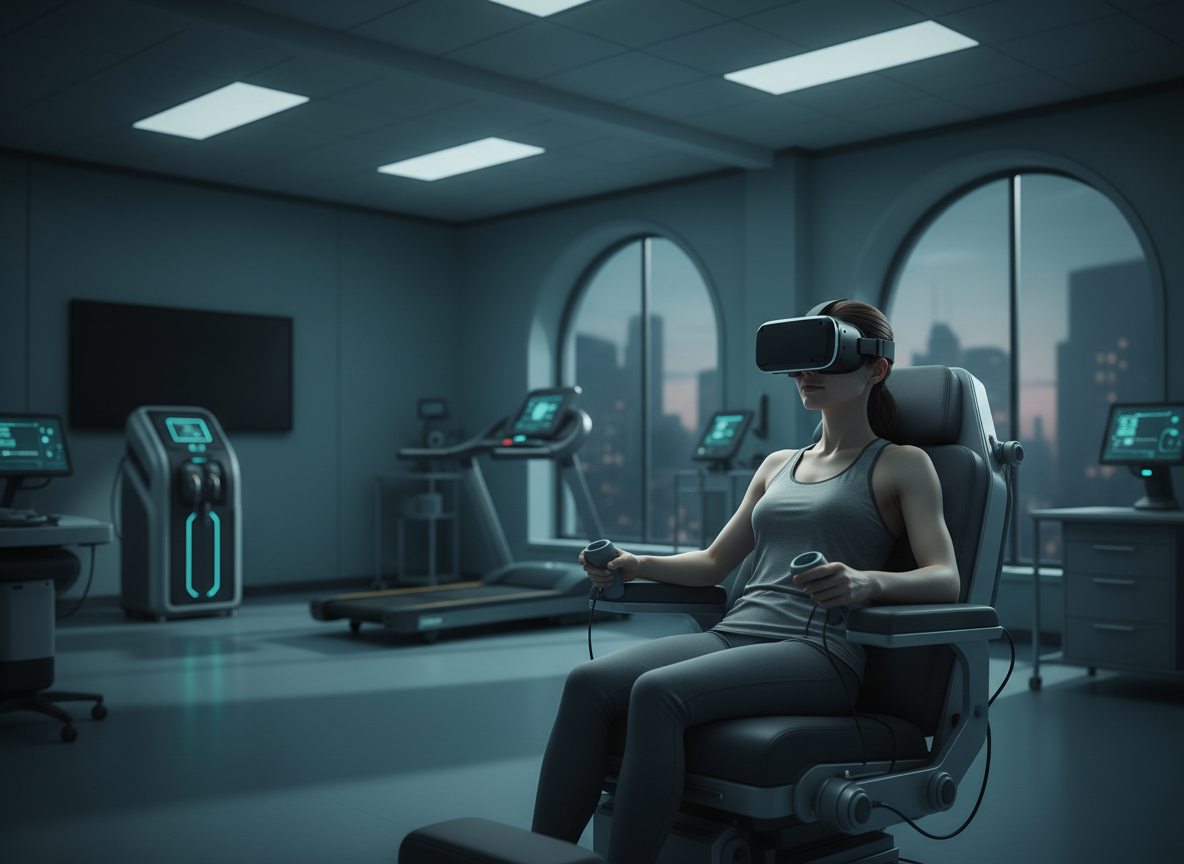
Virtual & Augmented Reality for Dizziness & Vertigo Treatment
Cutting-edge technology meets evidence-based vestibular rehabilitation — helping patients with dizziness, vertigo, and balance disorders reclaim their lives.
Backed by systematic reviews published in Scientific Reports (Nature)
What Are Virtual Reality & Augmented Reality?
If you’ve heard these terms but aren’t sure what they mean — you’re not alone. Here’s a simple breakdown of each technology and why they’re becoming powerful tools in modern vestibular rehabilitation.
🥽 Virtual Reality (VR)
A fully immersive digital world.
Virtual Reality replaces your entire field of vision with a computer-generated environment. Using a headset worn over your eyes, you are transported into a 3D world that responds to your head movements in real time. In a clinical setting, VR can simulate environments that gently challenge your balance system — such as busy street scenes, moving platforms, or visual flow patterns — in a safe, controlled way.
Because VR controls everything you see, it is especially effective for retraining the brain-eye-inner ear connection that goes wrong in vestibular disorders.
📱 Augmented Reality (AR)
Digital elements layered over the real world.
Augmented Reality keeps you in your real environment but overlays it with digital images, animations, or visual cues — through a tablet, smartphone, or specialized glasses. Unlike VR, you can still see your actual surroundings, making AR a useful tool for patients who are sensitive to full immersion or who need to practice in their real-world environment.
In vestibular rehab, AR can project moving visual targets or optokinetic patterns into your real space, helping your brain gradually adapt to challenging visual stimuli.
Why Does This Matter for Dizziness & Vertigo?
Vestibular disorders — including vestibular hypofunctions, labyrinthitis, vestibular neuritis, Meniere’s disease, and persistent postural-perceptual dizziness (PPPD) — often cause the brain to misinterpret signals from the inner ear, eyes, and body. VR and AR give therapists precise control over the visual environment, allowing them to safely recreate the exact conditions that trigger your symptoms — and systematically train your brain to overcome them. This is something traditional therapy tools simply cannot replicate with the same precision.
Sources: Veras et al. (2021), Scientific Reports — Virtual and augmented reality in the vestibular rehabilitation of peripheral vestibular disorders: systematic review and meta-analysis. PMC8426502 | Vestibular Disorders Association (VeDA) | APTA Clinical Practice Guidelines (2022)
What the Research Says
This isn’t experimental fringe science — VR and AR for vestibular rehabilitation is backed by a growing body of peer-reviewed clinical trials and systematic reviews. Here’s what the evidence shows:
📊 Systematic Review & Meta-Analysis
VR Outperforms Traditional Therapy for Dizziness
A landmark 2021 systematic review and meta-analysis published in Scientific Reports (Nature) analyzed multiple randomized controlled trials and found that VR and AR-based vestibular rehabilitation produced significant improvements in dizziness, balance, and quality of life — often outperforming conventional therapy alone.
Veras et al., Scientific Reports, 2021 — PMC8426502
🧠 Randomized Controlled Trial
VR Reduces Symptoms of PPPD
A randomized controlled trial published in 2021 found that customized vestibular exercises combined with optokinetic stimulation via mobile VR produced significant short-term improvements in patients with Persistent Postural-Perceptual Dizziness (PPPD) — one of the most challenging vestibular conditions to treat.
PMC8280184 — Frontiers in Neurology, 2021
👴 Randomized Controlled Trial
VR Effective in Elderly Patients with 6-Month Follow-Up
A 2022 randomized controlled study found that VR-supported vestibular rehabilitation using 3D real-life video on smartphone/VR glasses produced significant improvements in elderly dizzy patients — with benefits maintained at both short-term and long-term 6-month follow-up.
PMC9760985 — International Journal of Environmental Research and Public Health, 2022
⚖️ Randomized Controlled Study
VR Improves Balance in Chronic Vestibular Hypofunction
A 2023 randomized controlled study found that virtual reality therapy produced meaningful improvements in balance and dizziness in patients with chronic unilateral vestibular hypofunction — a condition where one inner ear is permanently underperforming. VR provided a safe, engaging, and effective training environment.
PubMed 37674792 — 2023
Across multiple conditions — BPPV, vestibular neuritis, labyrinthitis, PPPD, vestibular hypofunction, and post-concussion dizziness — the evidence consistently points in one direction: VR and AR make vestibular rehabilitation more effective.
All studies referenced are peer-reviewed and indexed in PubMed / PubMed Central (PMC). Results may vary by individual condition and severity.
Why Choose In-Home VR Vestibular Therapy?
Most clinics don’t offer this. We do — and we bring it directly to you.
🏠
Therapy in Your Own Home
No waiting rooms. No driving while dizzy. We come to you — making every session safer, more comfortable, and more functional.
🎯
One-on-One, Every Session
You get your therapist’s full, undivided attention — not a tech or an aide. Every exercise is monitored and adjusted in real time.
🥽
VR + Manual Therapy Combined
We pair cutting-edge VR technology with hands-on manual therapy when appropriate — a combination most clinics simply can’t offer.
🏆
Certified Vestibular Specialist
Not a generalist. Your therapist is specifically trained and certified in vestibular rehabilitation — it’s why we started this business.
📈
Measurable Results
We track your progress using validated clinical outcome measures — so you can see exactly how far you’ve come.
Ready to Find Out If VR Vestibular Therapy Is Right for You?
Book a free discovery call and speak directly with a certified vestibular therapist.
How VR & AR Fit Into Vestibular Rehab
Here’s how VR and AR look in a real vestibular therapy session, step by step.
Step 1: Comprehensive Assessment
Your vestibular therapist first tests your eye movements (VOR), balance, gait, and dizziness triggers to find the root cause.
Every program is individualized.
Step 2: Customized VR\/AR Exercises
Based on your assessment, your therapist builds VR or AR exercises that target your specific triggers and symptoms.
Safe. Controlled. Gradually harder.
Step 3: Progress Monitoring & Real-World Integration
As your brain adapts, your VR challenges increase and then transition into real-world tasks.
Trackable gains. Everyday impact.
Conditions We Treat with VR & AR
- Vestibular Neuritis & Labyrinthitis
- Persistent Postural-Perceptual Dizziness (PPPD)
- Unilateral & Bilateral Vestibular Hypofunction
- Meniere’s Disease
- Post-Concussion Dizziness & Vestibular Migraine
- Age-Related Balance Disorders
- Central Vestibular Disorders
What to Expect from Your Sessions
- In-home sessions done in the comfort of your space
- Therapist-guided VR\/AR exercises every visit
- Slow, symptom-guided progression
- Manual therapy added when helpful
- Simple home exercises between sessions
- Regular re-checks with validated outcome tools
- Clear discharge goals and return-to-activity plan
PATIENT TESTIMONIALS
What Patients Are Saying About Vestibular Therapy
⭐⭐⭐⭐⭐
Tim came to our house to evaluate my husband with a severe case of dizziness with nausea. It was so convenient and helpful to have him come to us with the severity of my husband’s symptoms. Tim was wonderful evaluating him — very thorough and explained what he found and how we were going to address it. We have never had a more thorough physical therapy evaluation. Beyond the thoroughness and expertise, he was extremely compassionate and caring. We cannot recommend Tim enough!
Stephanie Stefano
— Google Review ⭐⭐⭐⭐⭐
⭐⭐⭐⭐⭐
Vertigo cured in just 1 vestibular therapy visit! Our elderly loved one had a severe recurrence of vertigo — room spinning, nausea, and fearful to walk. Dr. Thomas came to our house the next day. After a 1.5–2 hour evaluation and treatment, our loved one was 100% symptom free after just one session. If you or a loved one has vertigo, I highly recommend calling Dr. Thomas!
Mike Hohs
— Google Review ⭐⭐⭐⭐⭐
⭐⭐⭐⭐⭐
I was completely discouraged and depressed about my vertigo issues when I reached out to Tim. I was able to get an appointment within 3 days and Tim came to my home for vestibular physical therapy. Tim was very knowledgeable and I learned a lot about BPPV. My vertigo was gone with only one session!
Miranda Martinez
— Google Review ⭐⭐⭐⭐⭐
 Home
Home 